
Most painting businesses say they do quality work. The problem is that every other painter says the same thing.
If a homeowner or builder is comparing three or four options, they are looking for proof. Not promises. That proof usually comes down to two things. Customer reviews and real project photos.
These are not nice extras. They help people trust your business faster. They help your website convert better. They help your Google Business Profile look active. They also give prospects a clearer idea of what kind of jobs you take on, where you work, and whether your finish matches what they want.
For painting businesses trying to get more enquiries from search, this matters. If you want broader painter marketing and SEO support, reviews and project imagery should be part of the plan, not an afterthought.
Why proof matters more than claims
Painting is a trust service. People are inviting you into a home, an office, a strata property or a commercial site. They want to know you will show up, communicate well, protect surfaces and leave a clean result.
Your words can say that. Reviews and photos can prove it.
When someone lands on your site or your Google Business Profile, they are often asking silent questions:
- Have they done this kind of job before?
- Do customers actually recommend them?
- Can I see the standard of finish?
- Do they work in my area?
- Are they active right now or does this business look neglected?
Strong proof helps answer all five.
Reviews reduce hesitation
Reviews are one of the fastest ways to reduce doubt. A prospect may not know how to judge prep work, paint systems or coating selection. But they do know how to read customer feedback.
Good reviews tell people what it is like to deal with you. They often mention the details that matter most:
- Arrived on time
- Easy to communicate with
- Clear quote
- Finished when promised
- Tidy worksite
- Great finish
- Helpful with colour decisions
- Professional crew
That is the language future customers are already thinking in. When they see those points repeated by real clients, trust starts building before the first phone call.
What makes a review useful for a painter
Not all reviews carry the same weight. The best ones are specific. A short five-star rating helps, but a detailed review gives context.
For example, a review that says, “Excellent painter” is fine. A review that says, “They repainted our weatherboard exterior in Randwick, fixed peeling sections, kept the site tidy and finished ahead of schedule” does far more work.
That kind of feedback helps in three ways:
- It confirms workmanship
- It adds service detail
- It reinforces location relevance
That last point matters more than many painters realise. If your reviews mention suburbs, property types and job styles, they help future customers see that you work in places like theirs.
Project photos show the finish people are buying
Painting is visual. People want to see the result.
A strong gallery can do what a sales paragraph cannot. It can show line quality, neat cut-ins, restored surfaces, crisp trims, refreshed facades and clean commercial finishes. It can also help customers picture the result on their own property.
Photos are especially valuable because many painting jobs sound similar on paper. “Interior repaint” could mean anything from one rental unit to a full premium home fit-out. “Exterior painting” could be a rendered townhouse, a weatherboard home or a large strata block.
Images remove guesswork.
What to include in project photos
Use real job photos, not stock images. Show the kind of work you want more of.
- Completed shots from multiple angles
- Close-ups of detailed areas like trims, cornices or doors
- Wide shots that show the full job
- Different property types such as homes, offices and commercial spaces
- Photos from suburbs or regions you service
- Short captions explaining the work completed
If you want more exterior repaints, show more exteriors. If you want commercial work, show clean, well-documented commercial projects. Your gallery should not be random. It should support the jobs you want to win.
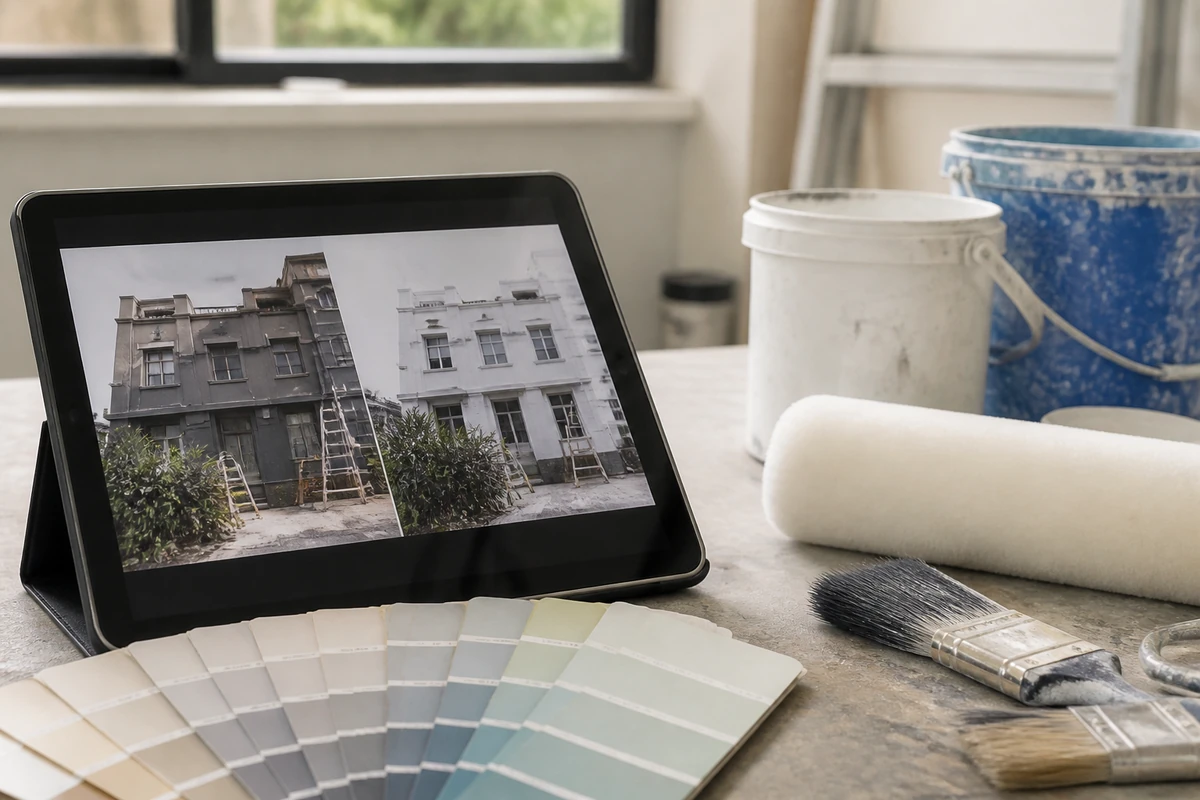
Before and after images make the value obvious
Before and after photos are even stronger than standard gallery images because they show the change.
People do not just buy paint. They buy an improved result. Better street appeal. A fresher interior. A cleaner tenancy handover. A commercial site that looks maintained and professional.
Before and after images make that change easy to understand at a glance.
They also help justify price. If someone sees the condition of the original surface, then sees the finished result, they are more likely to appreciate the prep, product choice and labour involved.
Best uses for before and after images
- Faded or peeling exterior repaints
- Water-damaged interior repairs
- Kitchen cabinet refinishing
- Deck and timber restoration
- Commercial refresh projects
- End-of-lease repaint work
Keep these images honest. Do not over-edit them. Use similar angles and lighting where possible. Add a short caption so viewers know what changed and what work was done.
Location relevance helps the right customers trust you faster
Painters often work across a service area, not just one suburb. But local relevance still matters. People want to hire someone who understands the area, the property styles and the practical issues that come with them.
Reviews and project photos can help with that.
If your review mentions a suburb and your photo caption names the area or nearby project type, that creates a stronger local signal for prospects. It also makes your business feel more familiar.
For example, someone in the Inner West may respond well to examples from terrace homes, while someone in a newer estate may want to see modern exterior repaints. A commercial property manager may look for office, retail or strata examples near their own sites.
This does not mean stuffing suburb names everywhere. It means documenting real work in real places.
Simple ways to build local relevance
- Add suburb names naturally in review request prompts
- Caption project photos with the service and area
- Group related projects by service type and location on your website
- Post recent jobs to your Google Business Profile
- Mention property style where it helps add context
If you are also working with an hands-on SEO help in Sydney, this kind of real-world location proof becomes much more useful than vague claims about servicing “all areas”.
Google Business Profile activity builds confidence
Many painting businesses claim their Google Business Profile matters, then leave it untouched for months. That is a missed opportunity.
An active profile helps you look current. It gives prospects more to review before they call. It also shows Google that the business is being maintained.
For painters, the profile is one of the best places to publish proof quickly:
- Recent project photos
- Before and after images
- Fresh reviews
- Service updates
- Posts about completed jobs
When someone finds your profile, they should not feel like they have discovered an abandoned listing. They should see signs of a real, operating business that is doing work now.
What to post on your profile
Keep it practical. A polished marketing message is less important than useful evidence.
- Exterior repaint completed in a named suburb
- Interior refresh for a rental property
- Office repaint completed after hours
- Before and after of timber restoration
- Short update about prep and finish on a larger project
Photos should be clean and real. Captions should be plain English. You do not need to write a mini essay. Just give enough detail to show what was done.
Proof of workmanship goes beyond the finished shot
A finished photo is great. But workmanship proof can go further.
Painting buyers are often worried about the process, not just the result. They want to know whether surfaces were prepared properly, whether care was taken, and whether the team worked professionally.
This is where your content can separate you from average competitors.
Ways to show workmanship clearly
- Photos of prep work before painting starts
- Images showing masking and surface protection
- Close-ups of repaired cracks or patched areas
- Captions explaining the scope of prep involved
- Reviews mentioning tidiness and attention to detail
- Short notes on coatings used where relevant
You do not need to turn every project into a technical article. But even a few details can change how a prospect reads your work. Instead of seeing “a painter”, they start seeing a professional operator with standards.
This is also where supporting content can help. If you are planning out service pages, the article Interior vs Exterior Painting Pages: What Should Be Separate? is a useful next step because different project types often need different proof.
Reviews and photos work better together
Do not treat reviews and imagery as separate assets. They are stronger when paired.
Imagine a project page with:
- A clear project title
- Three to six real photos
- One before and after comparison
- A short summary of the job
- A customer quote or linked review
- The suburb or service area
That simple structure can do a lot of heavy lifting. It shows the work. It shows the result. It shows that someone was happy enough to comment on it.
For a painting business, this is often more persuasive than writing another long paragraph about quality and service.
How to ask for better reviews
Most painters ask for reviews too late, too vaguely or not at all.
The best time to ask is right after the customer has seen the finished result and is happy with the job. Make it easy. Send a short message with a direct link. Be specific about what kind of feedback helps.
You are not scripting the review. You are guiding it.
A better review request sounds like this
You might say: “Thanks again for having us out. If you have a minute, we would really appreciate a Google review. If helpful, you could mention the type of painting work we did and the suburb.”
That gives the customer a prompt without sounding forced.
You can also ask office staff or project managers to build this into the close-out process so reviews are requested consistently, not only when someone remembers.
How to collect better project photos without slowing the job down
Good project photos do not need a professional photographer every time. They do need consistency.
Set a simple process for your team:
- Take a before shot from the front
- Take close-ups of problem areas
- Take one prep image if relevant
- Take finished shots from the same angle
- Save photos by suburb, service and date
Natural light helps. Clean frames help. So does avoiding bins, ladders and drop sheets in the final image where possible.
Over time, this gives you a usable library of proof instead of a camera roll full of random job photos no one can find later.
Where to place reviews and photos on your website
Do not hide your best proof on one gallery page and hope people find it.
Spread it across the site where it supports a buying decision:
- Homepage for immediate trust
- Service pages for relevance
- Location pages where local proof exists
- Project pages for detail
- Contact or quote pages to reduce hesitation
If someone lands on your exterior painting page, they should see exterior proof. If they land on your commercial painting page, they should see commercial jobs and reviews from those clients if available.
That same logic applies to site structure more broadly. For a practical follow-on read, see What Pages Should a Painting Business Website Have?.
Common mistakes painters make with trust proof
- Using stock photos instead of real work
- Only showing finished shots with no context
- Letting old reviews sit without collecting new ones
- Posting photos without captions or service details
- Ignoring Google Business Profile updates
- Keeping all reviews on third-party sites and none on the website
- Showing mixed, low-quality images that do not match target jobs
None of these issues are hard to fix. They just need a system.
What this means for painters who want more enquiries
If your marketing is not producing enough quote requests, start by looking at the proof on the page. Not just the copy.
Ask yourself:
- Do we show real jobs?
- Do we show before and after results?
- Do our reviews mention specific work and locations?
- Does our Google Business Profile look active?
- Would a stranger trust us after five minutes on our site?
If the answer is no, fix that first.
Painting is a proof-led service. Strong reviews, useful project photos, local context and visible workmanship help people choose you with more confidence.
Want more of the right leads? Start documenting your work properly, ask for better reviews, and make sure that proof is easy to find wherever prospects first discover your business.