Getting traffic is only half the job.
If a painting website attracts visitors but fails to turn them into calls or quote requests, the site is not doing its real work. Too many painters spend money getting found, then send people to pages with weak service copy, poor layouts, no trust signals and clunky forms.
The better approach is simple. Make it easy for the right visitor to take the next step. That means clear service pages, visible phone numbers, strong proof, mobile-friendly design and a follow-up process that does not let good enquiries go cold.
If you have not sorted your site structure yet, start with What Pages Should a Painting Business Website Have?. Once the right pages exist, the next job is turning those visits into real quote opportunities.
Start with the main conversion paths
Most painting websites only need a few core conversion paths. The mistake is hiding them, overcomplicating them or forcing every visitor into the same action.
For painting businesses, the main paths are usually:
- Phone calls for people who want fast answers
- Quote forms for people comparing options or messaging after hours
- Service pages that move visitors toward the right next step
- Project proof that reduces hesitation
- Trust signals that make the business feel safe to contact
A homeowner looking for exterior painting may want to call now. A strata manager may prefer a form with job details. A commercial client may need proof that you handle larger projects. Your website should support each of those behaviours.
Make phone calls the easy option
Many painting jobs start with a quick chat. The visitor wants to ask about timing, service areas, prep work or whether you handle residential or commercial jobs.
If calling is important to your business, treat the phone number like a primary action, not an afterthought in the footer.
What helps
- Put the phone number near the top of the page
- Use click-to-call on mobile
- Repeat the phone number on key service pages
- Add short call prompts like Call for a fast quote discussion
- Show service hours if you do not answer all day
This matters because many painting leads are ready to act. If your number is hard to find, they will often bounce and ring the next painter.
A common example is someone searching on their phone after seeing peeling exterior paint or needing a rental property freshened up before new tenants move in. They do not want to hunt for contact details. They want one tap and a quick answer.
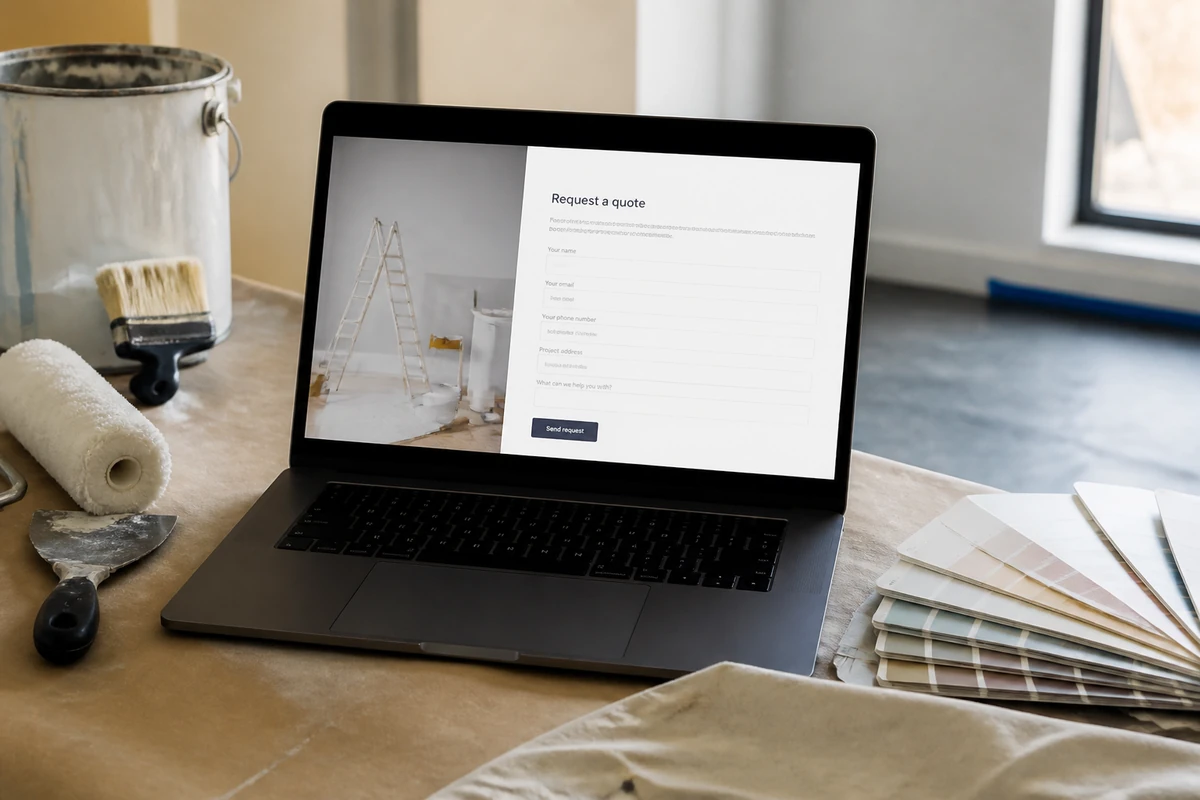
Build quote forms people will actually finish
Quote forms should help you get useful details without creating friction. If the form feels long, confusing or unnecessary, enquiry rates drop.
The sweet spot is usually a short form that captures enough to qualify the lead.
Good fields for a painting quote form
- Name
- Phone
- Suburb or job location
- Type of work
- Short project details
You can add optional fields like timeline, property type or preferred contact method, but keep the form tidy.
Avoid forms that ask for too much too early. Room-by-room detail, exact square metre estimates and long checklists can wait until after contact. The first goal is getting the enquiry.
What makes forms convert better
- Clear heading such as Request a Quote
- A short line explaining what happens next
- Minimal required fields
- Large fields and buttons on mobile
- No awkward captcha experience
- A thank you message that sets expectations
Good expectation-setting matters. Tell people when you will reply. Even a short line like We aim to respond within one business day can reduce doubt and improve form completion.
Turn service pages into decision pages
Service pages should not just describe what you do. They should help a visitor decide whether to contact you.
That means each core service page needs to answer the practical questions buyers have in their head.
For residential pages
- What jobs do you handle
- What areas do you service
- What is included in prep and finish
- How can they request a quote
- Why should they trust your team in their home
For commercial pages
- What project types do you take on
- Can you work around site requirements and access windows
- Do you handle larger scopes or staged works
- How do they start the quoting process
- What proof do you have of similar work
Each page should include a clear next step. Not a vague contact link. A real call prompt or quote form prompt tied to that exact service.
That is one reason good service page planning matters so much. If you want stronger support around this area, see painting website SEO support for the broader strategy behind service pages, local search intent and enquiry growth.
Use proof photos to remove doubt
Painting is visual. People want proof.
Before and after photos do more than make a site look better. They answer the silent question every prospect has: Can these people do a good job on a property like mine?
The strongest proof photos are not random gallery filler. They support buying decisions.
What to show
- Before and after comparisons
- Interior and exterior examples
- Residential and commercial work if you do both
- Different surface types or project sizes
- Short captions with location or project type where appropriate
For example, a simple project block on an exterior house painting page might show faded weatherboards before, the finished result after, and a short caption explaining the repaint scope. That gives the visitor a reason to trust the quote request step.
Photos also work best when placed near conversion points. Do not hide all proof on one gallery page. Put relevant proof on service pages, near CTAs and close to quote forms.
Add trust signals where hesitation happens
Not every visitor is ready the second they land on your site. Some are checking whether your business looks legitimate, reliable and safe to deal with.
Trust signals help tip that decision.
Useful trust signals for painters
- Recent reviews
- Licence or insurance details where relevant
- Years in business if accurate
- Clear service area information
- Real team or business photos
- Process steps for quotes and job delivery
- Project examples matched to the service page
Trust signals work best when they are specific. A generic claim like high quality work means very little. A page that shows recent review snippets, real project photos and a clear quote process feels far more credible.
For commercial jobs, trust may also come from signs that you understand planning, access, site communication and job coordination. For residential jobs, it may come from clean presentation, friendly language and signs that your team respects the home.
Design for mobile first, not desktop first
Many painting leads will first hit your website on a phone. If the mobile experience is awkward, your conversion rate suffers fast.
This is where good businesses lose easy work. The traffic may be fine. The site may even look acceptable on desktop. But on mobile, the text is cramped, the button is buried, the phone number is not tappable and the form is painful to use.
What a mobile-friendly painting page should do
- Load quickly
- Show the main action early
- Use large readable text
- Keep buttons easy to tap
- Use short sections, not giant walls of copy
- Keep forms simple
- Make phone calls one tap away
Think about real user behaviour. A property owner might be standing outside looking at a faded fence. A facilities manager might be checking suppliers between meetings. A landlord may be comparing painters after hours. In all of those moments, convenience matters.
If mobile users have to pinch, zoom, scroll forever or guess what to do next, enquiries drop.
Match each page to one clear next step
Not every page needs the same CTA.
A homepage may offer both a phone call and a quote request. A service page may push a quote form more strongly. A project page may link to the relevant service page and then toward contact.
The important thing is clarity.
Visitors should not finish a page wondering what happens next. Every key page should answer that question.
Examples
- Interior painting page: Request a room repaint quote
- Exterior painting page: Call to discuss prep, access and timing
- Commercial painting page: Send project details for a tailored quote
- Gallery page: View the relevant service and request a quote
When the CTA fits the page intent, conversion rates usually improve because the next step feels natural.
Track enquiries so you know what is working
You cannot improve conversions if you do not know where leads come from.
Many painters judge their website by feel. That creates blind spots. You may think one page performs well when most good enquiries are actually coming from another service page, phone calls from mobile, or a suburb page with stronger intent.
At minimum, track
- Phone call clicks from the website
- Form submissions
- Landing pages that generate enquiries
- Mobile versus desktop conversion behaviour
- High-intent pages with weak conversion rates
If you are investing in growth, measurement should be part of the plan. It also helps when budgeting, because you can compare lead quality with spend and ask smarter questions around SEO cost Australia rather than treating marketing like guesswork.
Tracking also shows where fixes are needed. For example, if a page gets good traffic but weak form submissions, the issue may be the CTA, the proof, the form length or the mobile layout rather than the traffic source itself.
Speed matters after the lead comes in
Conversion does not stop at the form submission.
A lot of painting businesses lose work because follow-up is slow, inconsistent or vague. A website can do its job, but if the enquiry sits unanswered for a day or two, that lead may already be booked elsewhere.
A simple follow-up system helps
- Send an instant confirmation email
- Reply quickly during business hours
- Call back missed leads promptly
- Use a basic lead sheet or CRM
- Record job type, suburb and source
- Set reminders for quotes not yet sent
This does not need to be fancy. It just needs to be reliable.
For example, if someone requests a quote for exterior repainting in a priority suburb, your team should know about it fast, respond clearly and keep the process moving. That is how website traffic turns into revenue, not just inbox clutter.
Common website mistakes that cost painters enquiries
Most conversion problems are not dramatic. They are small issues that stack up.
- No visible phone number near the top of the page
- Weak or missing service pages
- Only one generic contact page doing all the work
- No proof photos near the CTA
- Long forms with too many required fields
- Mobile layouts that are hard to use
- No review signals on key pages
- Slow follow-up after form submissions
- No enquiry tracking
Fixing even a few of these can improve the number of quote requests without needing more traffic straight away.
What a better conversion setup looks like
A strong painting website usually follows a simple path.
- The visitor lands on a relevant service page
- The page clearly explains the service and area fit
- Proof photos and trust signals reduce hesitation
- A phone number and form are easy to use
- The enquiry is tracked properly
- The business follows up quickly
That is the difference between a website that just looks decent and a website that helps win work.
Final thought
If your site gets visits but not enough quote requests, do not assume the problem is traffic. Often the issue is conversion design, proof, page intent or follow-up.
Make the next step obvious. Show real proof. Keep mobile easy. Track what matters. Then respond fast when leads come in.
If you want help improving how your painting website turns visitors into enquiries, Sejuce Digital can help you tighten the pages, CTAs and lead flow that drive more quote requests.